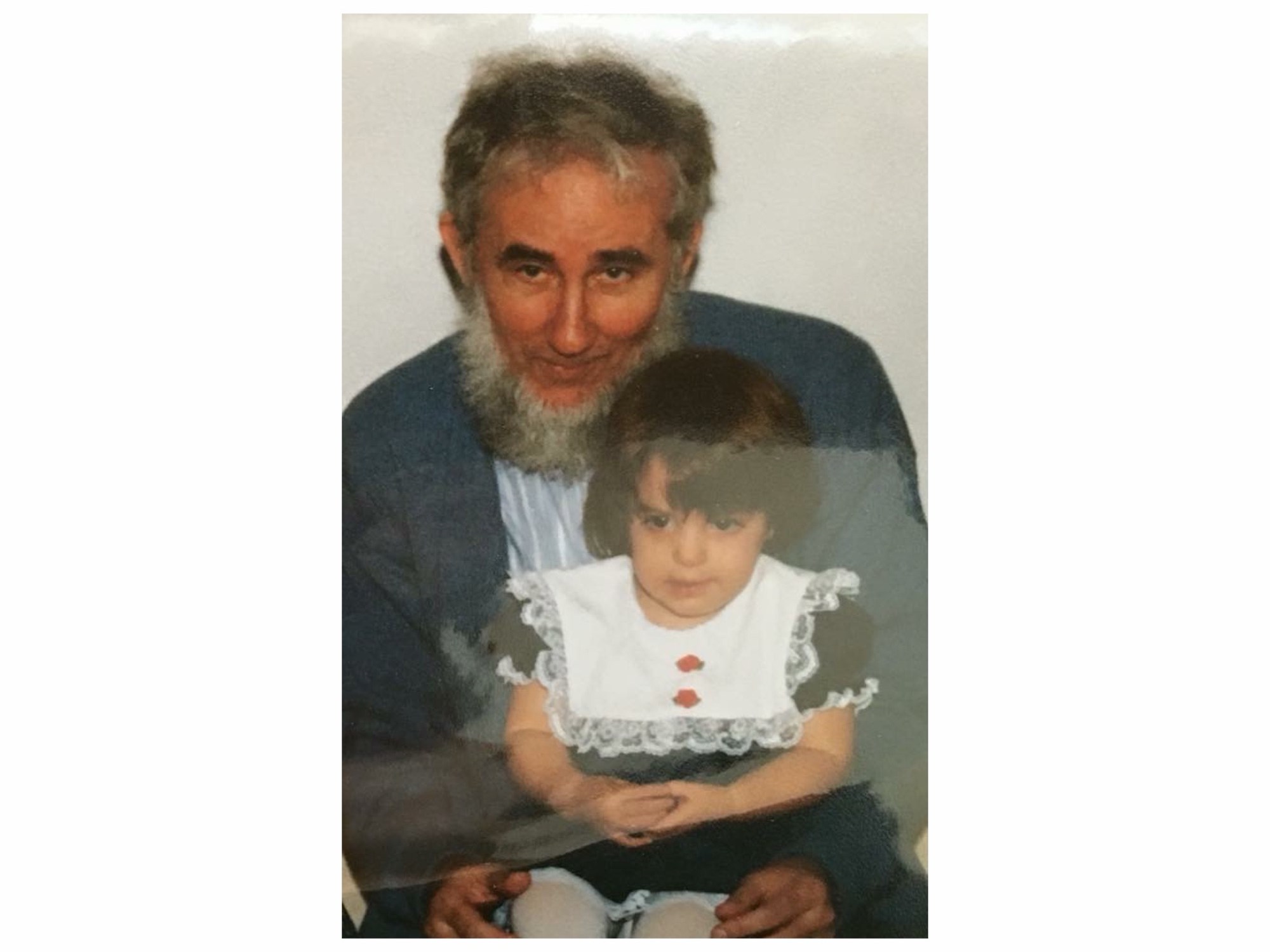
Yesterday was Father’s Day.
The days leading up to it, I talked a lot about my dad. I felt close to him so the day didn’t feel as heavy as it probably could have. I didn’t isolate too much. I did a puzzle with my mom, made a big breakfast for us, talked to one of my best friends for an hour on the phone, made dinner, took an everything shower and then read some of a new book while lightning lit up the sky from a distant storm.
When my dad died, my uncle had sent me a paper that he published when he worked at Boeing. The title of the file was “Ada Compiler Testing” and in my unbelievable ignorance I thought “well that’s weird my dad never mentioned doing anything for ADA compliance for planes?”. Well, he didn’t, and that’s why he never mentioned it. Turns out my dad co-authored technical publications for Boeing and the U.S. Air Force in the early 1990s related to the Ada Compiler Evaluation Capability (ACEC). ACEC is basically the testing grounds for Ada Compilers, which are essentially the software tools that take human language (or code) and translate it into binary (a bunch of 1’s and 0’s) that a computer can understand. Obviously, this was super important because these compilers were used in military and aerospace industries — so accuracy & reliability was extremely important. My dad’s work helped create the framework used to evaluate these systems and analyze the results. One of my good friend’s husband’s is a contracted mechanic for military planes, and as it turns out — that publication is still available in their database for the people in Avionics. Which means, even though his particular methods may not be used (the framework he was testing at the time was absorbed into other companies or is now obsolete) but the documentation is still there. It’s not archived. Which…to me…that’s pretty fucking cool. I had a really long cry about that. Happy tears, but also tears of wishing I could tell him that. Wishing I had known that & done the research on it when he was still alive. Maybe he knew & was too humble to brag? That’s also entirely plausible. My dad wasn’t much for public recognition.
While talking about this with my friend, she did some more digging and found that my dad co-authored a couple of articles in 1975 that are, apparently, still widely cited today. She found his work cited in research published by Oxford, Duke University, Cambridge University, research by sociologists in Japan and other countries, even the U.S. Commission on Civil Rights. His work is published in the American Sociological Review and the American Journal of Sociology. The titles of the articles are “Sex and the Process of Status Attainment: A Comparison of Working Women and Men” and “The Process of Status Attainment in the United States and Great Britain”, respectively. The articles are under some sort of paywall thing that I can’t access, but I did reach out to the University of Chicago Press Journal to ask for them. The titles alone sound like an impressively progressive analysis of status back in 1975. I hope that I can gain access to them somehow and read them. I would love to know what ideas he had presented that are still so important to so many people.
In addition to that, I found my dad’s college thesis. The title being “A Comparison of Six Quantified Balance Models”. I tried to read it once and all it said to me was “math math math math”. So I did what any normal person would do and ran the first chapter through AI to make it make sense to me. Turns out? Yes, math. But also? He was asking (and trying to understand) why do people feel psychological tension when their relationships, beliefs, and opinions don’t seem to fit together. Using mathematical and statistical models, he compared six different theories of “balance” in human relationships and attitudes. He compared 5 different mathematical models and also decided to create his own. He basically took the psychological idea that “people like consistency” and turned it into a mathematical problem involving geometry, distance, balance, and competing predictive models, then he tested which model best explains how people actually feel. Not only is that the nerdiest shit I’ve EVER heard in my life, but it is VERY ON BRAND for my father. IYKYK.
I don’t know how much my dad cared about holidays, especially the Hallmark Holidays made up to sell cards & gifts dressed up as a celebration of a person or figure in your life that should, honestly, be celebrated on any given Tuesday instead of just a chosen random day in June. In fact, I’m not even sure he would have known yesterday was Father’s Day if he was still alive. Often when I’d call to tell him happy Father’s Day he’d sound surprised, as if the holiday didn’t even register in his mind. Was that his way of ensuring that, if I didn’t call, he wouldn’t be sad about it? Given that he was studying and trying to make sense of people using math — I’m thinking the day held a little more weight than he verbally acknowledged.
I’ve spent a lot of time as I’ve grown up trying to understand my dad and already saw a lot of him in me before he died, and ESPECIALLY now that he’s not here in the flesh for me to run ideas past him or talk about my day — that I see all the ways he still lives on in me more clearly.
I would’ve given anything yesterday to give him a salami and cheese gift set & talk about politics and what the 60s and 70s were like. Only this time, I would’ve asked different questions. I would ask why he was so interested in the things he was. I would ask what he learned. I would ask what kinds of conversations his studies and papers sparked with other people. I would ask if he ever found the answers he was looking for, knowing that he was looking for answers that he probably only found in his final days, or even after he left this physical world, or maybe never. Maybe those aren’t questions that are supposed to be answered and yet he remained curious enough to spend his life asking them.
My dad was an atheist. Albeit he tried really hard to prove if God existed (at least for himself) in a scientific or mathematical way that made sense to him. It never did, and that’s okay. He read countless books, including the Bible and a few other religious texts, and was well-informed on his decision that God didn’t exist and there was no proof. The argument I’d provide back to him was always “then why do people have faith there’s something bigger?”
Because he was an atheist, I find it hard to relate to people who say “he’s watching over you from a better place.” Is he though? I mean, his ashes ARE in an urn on the top of a shelf, so like…technically it is above me, but I don’t think that’s entirely what they mean when they say that. And the way they mean it is assuredly from a place of care and sympathy, but it just doesn’t fit for my dad. So what does fit? Well, science fits. Laws of thermodynamics and the scientifically proven FACT of the law of conservation of energy that it is never created or destroyed, it simply changes form. Energy is constant. The atoms and molecules that make us who we are today — when we die, are given back to the earth and the atmosphere. You may not have consciousness anymore, but the energy, mass, and space that you took up as a living, breathing, biological being, are simply returned to the universe and effectively recycled indefinitely.
So while my dad wasn’t physically here for me to celebrate and love and thank and all the things kids do for their dads on that day — I celebrate him and feel him and love him in every way I speak, work, think, write, read, cook, love, and simply…exist.
So happy Father’s Day, dad. I miss you with every fiber of my being. And all of those fibers will continue to live on because you lived. And that’s a remarkably infinite fact. I am my father’s daughter, and I am so fucking proud to be that. Love you forever, daddy-o.

